What is a Ball Valve?
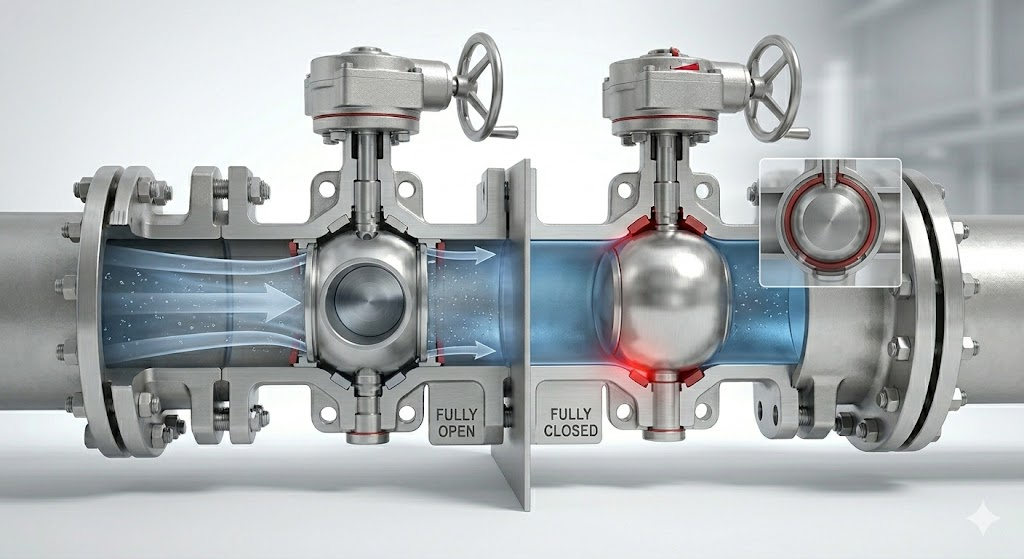
A Ball Valve is a form of quarter-turn valve which uses a hollow, perforated, and pivoting ball to control flow through it. It is open when the ball's hole is in line with the flow and closed when it is pivoted 90-degrees by the valve handle. Ball valves are durable, performing well after many cycles, and reliable, closing securely even after long periods of disuse. They are excellent for shut-off and control applications in various industrial sectors.
Working Principle
The working principle of a ball valve involves a ball with a hole (bore) through the center. When the handle is turned, the ball rotates to either align the hole with the inlet and outlet ports (open) or place the solid part of the ball against the flow path (closed). This design allows for a very tight seal and minimal pressure drop when fully open. Ball valves can also be used for throttling, though they are primarily designed for isolation.
Technical Specifications
| Size Range | 1/2" to 12" (DN15 to DN300) |
|---|---|
| Pressure Rating | Class 150, Class 300, PN16, PN40 |
| Material | WCB, Stainless Steel (CF8/CF8M), Forged Steel |
| Temperature Range | -20°C to 250°C (PTFE seat) |
| End Connections | Screwed (NPT/BSP), Flanged, Socket Weld |
| Design Standards | API 6D, ASME B16.34, BS 5351 |