What is a Butterfly Valve?
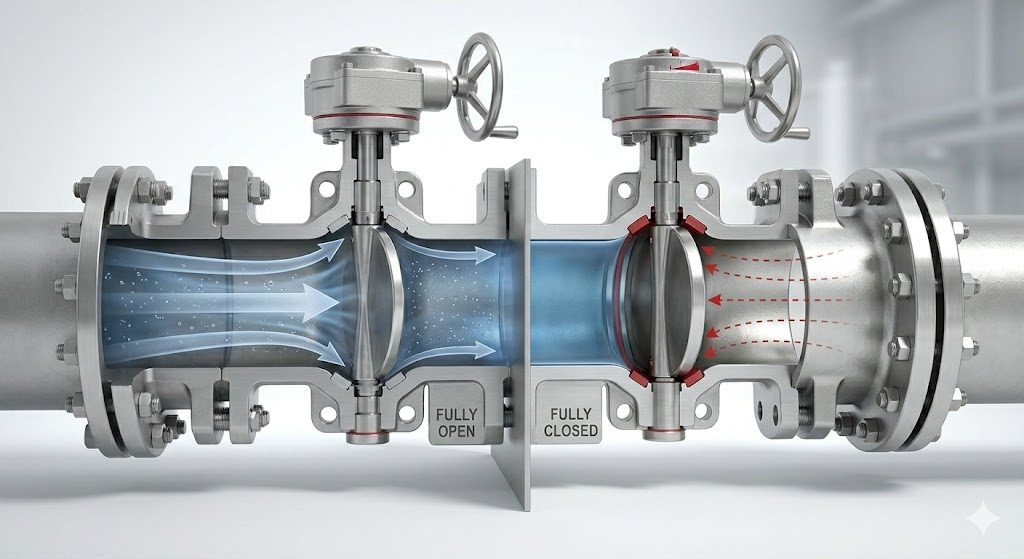
A Butterfly Valve is a quarter-turn rotational motion valve used to stop, regulate, and start flow. The "butterfly" is a metal disc mounted on a rod. When the valve is closed, the disc is turned so that it completely blocks off the passageway. When the valve is fully open, the disc is rotated a quarter turn so that it allows an almost unrestricted passage of the fluid. They are favored for their compact design and cost-effectiveness in large pipe diameters.
Working Principle
The butterfly valve operates by rotating a disc 90 degrees within the pipe. The disc is connected to an external handle or actuator via a shaft. In the 'open' position, the disc is parallel to the flow, allowing fluid to pass around it. In the 'closed' position, the disc is perpendicular to the flow, sealing against a resilient or metal seat to stop the fluid. This simple yet effective mechanism allows for quick operation and reliable throttling capabilities.
Technical Specifications
| Size Range | 2" to 36" (DN50 to DN900) |
|---|---|
| Pressure Rating | PN10, PN16, Class 150 |
| Material | CI, DI, WCB, Stainless Steel (CF8/CF8M) |
| Temperature Range | -10°C to 200°C (resilient seat) |
| End Connections | Wafer, Lug, Flanged |
| Design Standards | API 609, AWWA C504, BS EN 593 |